
- News
- City News
- mumbai News
- Over 35 years, BNHS transformed degraded land into pristine forest
Trending
This story is from May 6, 2018
Over 35 years, BNHS transformed degraded land into pristine forest

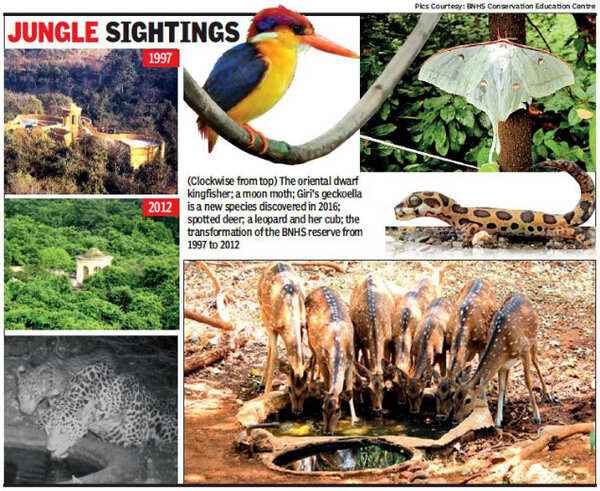
These tiny birds with yellow breasts, violet plumes and red crowns would swoop in and out of the water, multiple times a day, transforming bird lovers into frenzied paparazzi, who climbed atop the Conservation Education Centre’s kitchen counter to capture the perfect frame.

This abundance of wildlife has only been a common feature of the 33-acre reserve for the last 10-15 years. Before that, the land, which borders Goregaon’s Film City, was recovering from decades of human interference from nearby settlements and film studios. The recovery started in 1983, when the Government of Maharashtra offered BNHS this land for nature conservation activities. But recent media reports that the 30-year lease, which expired in 2013, may not be renewed, has worried conservationists and BNHS members, who fear returning the land to Film City will result in the destruction of the forest. This, despite the fact that CM Devendra Fadnavis visited the BNHS headquarters, opposite Lion Gate, in March and promised to renew the lease.
“I’m terribly disturbed,” says BNHS member and zoologist Parvish Pandya. “Everybody interested in wildlife and nature must take this up.” He recalls an anecdote that illustrates what would happen if the BNHS wasn’t constantly monitoring the reserve. One night in the 1990s, Pandya and other BNHS members found that trees inside the reserve were spray-painted silver for a Manisha Koirala movie. They raised a stink about the impact of the paint on the forest’s flora and fauna and it was quickly removed.
“Man can’t create a forest because it requires millions of years of evolution,” says Pandya. “You cannot bring back the spiders, the insects, the small species of fungi or mushrooms. It is impossible. You will have to wait for another million years for all these things to come back to life.”
In fact, even though this was forest land in 1983, returning it to its current pristine condition took 8-10 years. The BNHS started by hiring security guards to patrol the reserve, organizing a tree plantation drive and digging bunds so stream water would percolate into the land. Even the Conservation Education Centre (CEC) was built at different heights to avoid leveling the land and with open spaces to make way for existing trees.
As the tree cover returned, so did droves of paradise flycatchers, pied crested cuckoos and the beloved oriental dwarf kingfisher. “We started getting all these birds only in the last 10-15 years because of the increased canopy,” says BNHS Director Deepak Apte. “Before, it was all open, barren land with very little vegetation.” Nothing is a better indication of this transformation, he adds, than the return of the female leopard, who has now established the reserve as her territory.
Apte is certain the CM will renew the lease as soon as a reasonable rate is agreed upon.
“We got this 30-year lease at Rs 1 per year,” says Apte, “We have requested the government to continue with the same terms of reference but that’s something the government has to take a call on.”
The Conservation Education Centre (CEC) has trained so many of the city’s conservationists and naturalists that Pandya refers to it as a “living classroom and laboratory”. This is because the reserve is more diverse than the easily accessible parts of the national park, explains V Shubhalaxmi, who was in charge of the Centre from 2006-2014.
Besides budding environmentalists, the reserve also draws 20,000 school and college students, corporate employees, teachers and underprivileged groups annually for guided trails, leadership and corporate workshops and distance learning. And the Centre’s new butterfly garden attracts so many winged visitors, says Raju Kasambe, who is in charge of the CEC, that bipedal visitors don’t want to leave after attending the popular ‘Breakfast with Butterflies’ event.
End of Article
FOLLOW US ON SOCIAL MEDIA







Photostories

Hot Picks
TOP TRENDING
Popular Categories
Hot on the Web
Top Trends
Mohamed Muizzu India VisitIsrael Hezbollah WarAssembly Election Result 2024Travis KelceBiju GeorgeGautam GambhirKayla NicoleBasit AliInd vs China Stock MarketLalu Prasad YadavUGC NET ResultDiddyWomen's T20 World CupTop MBA Colleges of IndiaT20 WC ScheduleWomen T20 World Cup Points TableLive Cricket Score
Trending Topics
Bigg Boss 18 Launch LIVE UpdatesBigg Boss Tamil 8 Contestants ListBigg Boss Tamil 8 Launch LIVE UpdatesNavratri Colours 2024Navratri Day 2 ColourDurga Puja 2024Bigg Boss 18 House PhotoDevara CollectionNita AmbaniDeepika PadukoneGovindaDevaraGovinda NewsDevara Movie ReviewSwatantrya Veer SavarkarColdplay India tour 2025Watch NFL Live StreamDress To ImpressCall Of Duty Black Ops 6Wordle Answer
Living and entertainment
Latest News
1st T20I: Dominant India make quick work of BangladeshWorld famous Corpus Clock: A time piece and a haunting work of artRanveer Singh: I have a man crush on Tiger ShroffGhum Hai Kisikey Pyaar Meiin: Savi accuses Jigar of misbehaviourYouTube Shorts extends duration to 3 minutes5 must follow rules of Ayurveda to lose 5kg in 30 daysONGC Apprenticeship Recruitment 2024 registration begins: Check direct link hereWWE Hall of Famer Diamond Dallas Page signs new WWE Legends deal'Like a ghost': Manish Sisodia says Arvind Kejriwal has become PM Narendra Modi's 'sole obsession''Singham Again' Trailer: Ranveer Singh kisses wife Deepika Padukone's poster as she skips grand launch eventMy effort in internationalising Shatatantri Veena among the next generation seemingly paying dividends says Tarun Bhattacharya on his return from US TourOptical Illusion: Can you find who's the boss in this picture?'All teams will come to Pakistan for Champions Trophy': PCB chairman on India's participationCoin Master free spins and coins for 7 October, 2024: Earn million of coins using today’s linkIndustry upbeat on policy continuity as business confidence index rises to 2-quarter high: CIISeized vehicles, weapons used by Hamas in October 7 attack on display in IsraelCleveland Browns coach Kevin Stefanski said the team is “not changing quarterbacks” after Deshaun Watson's poor performanceIT companies appraisal, hike cycles shift from June to September quarter
Copyright © 2024 Bennett, Coleman & Co. Ltd. All rights reserved. For reprint rights: Times Syndication Service